Congruent Numbers and Elliptic Curves
December 06, 2016
A congruent number $n$ is a positive integer that is the area of a right triangle with three rational number sides. In equations, we are required to find rational positive numbers $a,b,c$ such that:
$\displaystyle a^2+b^2 = c^2$ and $\displaystyle n = \frac12 ab.$ (1)
The story of congruent numbers is a very old one, beginning with Diophantus. The Arabs and Fibonacci knew of the problem in the following form:
Find three rational numbers whose squares form an arithmetic progression with common difference $k$.
This is equivalent to finding integers $X,Y,Z,T$ with $T\neq 0$ such that $Y^2 - X^2 = Z^2 - Y^2 = k$ which reduces to finding a right triangle with rational sides
$\displaystyle \frac{Z+X}{T}, \frac{Z-X}{T}, \frac{2Y}{T}$
with area $k$. This is the congruent number problem for $k$. The Arabs knew several examples of congruent numbers and Fermat stated that no square is a congruent numbers. Since we can scale triangles to assume that $n$ is square free, this is equivalent to saying that $1$ is not a congruent number.
As with many other problems in number theory, the proof of this statement had to wait four centuries for Fermat. The problem led Fermat to discover his method of infinite descent.
In more recent times, the problem has been fruitfully translated into one about Elliptic Curves. We perform a rational transformation of the defining equations (1) for a congruent number in the following way. Set $x = n(a+c)/b$ and $y = 2n^2(a+c)/b$. A calculation shows that:
$\displaystyle y^2 = x^3 - n^2x.$ (2)
and $y \neq 0$. If $y = 0$, then $a=-c$ and $b = 0$ but then $n = \frac12 ab = 0$. Conversely, given $x,y$ satisfying (2), we find $a = (x^2-y^2)/y, b = 2nx/y$ and $c = x^2+y^2/n$ and one can check that these numbers satisfy (1).
The projective closure of (2) defines an elliptic curve that we will call $E_n$. We are interested in finding rational points on it that do not satisfy $y=0$. I will prove that $n$ is a congruent number precisely when $E_n$ has positive rank.
The proof is an interesting use of Dirichlet's Theorem on Arithmetic Progressions and some neat ideas about Elliptic Curves and their reductions modulo primes. I will essentially assume the material in Silverman's first book and the aforementioned Dirichlet's Theorem.
So far, we know that $n$ is a congruent number if and only if $E_n$ has rational points (x,y) with $y \neq 0$. Recall that for an elliptic curve in the standard Weierstrass form (as in (2)), $y = 0$ if and only if (x,y) has 2-torsion.
Therefore, our problem reduces to showing that the only torsion of $E_n$ is 2-torsion for all n. In fact, we always have non-trivial $2$-torsion and the points are given by $(0,0), (n,0),(-n,0)$ and the point at infinity.
Denote the m-torsion my $E_n[m]$. The rough outline of the proof is as follows:
- $E_n[m]$ maps injectively into the reduction of $E_n$ modulo a prime $p$ for all but finitely many primes.
- The number of $\mathbb F_p$ points of $E_n$ is independent of $p$ and equal to $p+1$ whenever $p \equiv 3 \pmod 4$.
- This would imply that $m|p+1$ for a set of primes $p$ of density $1/2$ but by Dirichlet's Unit Theorem, the set of such primes is of density $1/\varphi(m) < 1/2$ for all $m>4$.
Step 1:
Recall that the size of $E_n[m](\mathbb Q)$ is finite (and has exactly $m^2$ elements in $\overline{\mathbb Q}$. Also, recall that if $(x_1,y_1,z_1)$ and $(x_2,y_2,z_2)$ are two points in the projective plane (over any field $k$), then they are equal if and only if
$\displaystyle x_1y_2-x_2y_1, x_1z_2-x_2z_1, y_1z_2-y_2z_1$ (3)
are all $0$. Thinking of our $E_n$ has embedded in the projective plane, reduction modulo $p$ is simply reduction on each of the co-ordinates. Therefore, if we pick any finite set of $\mathbb Q$ points on $E_n$, then for any prime $p$ greater than any of the prime divisors of (3) , it's reduction will be non-zero.
Since $E_n[m]$ is a group, this is sufficient to show that the reduction map is injective for all but finitely many primes $p$ (once we fix $m$).
Step 2:
Fix a prime $p$. One could prove this by an explicit calculation involving quadratic characters but there is a neater way assuming some knowledge about the endomorphism ring $R_n = \mathrm{End}_{\mathbb F_p}(E_n).$ The relevant facts are the following:
- Over a finite field $\mathbb F_q$, the endomorphism ring is either an order in a quadratic imaginary field or an order in a quaternion algebra.
- Further, over $\mathbb F_p$ with $p>5$, the latter case occurs precisely when the number of elements on the curve is $p+1$ and the curve is called supersingular.
- In either case, for any endomorphism $f$, there is a dual $\hat f$ such that $N(f) = f\circ\hat f$ is multiplication by the degree of $f$, which is always non-negative.
A few words about the above statements: They are in true for all Elliptic curves and not just $E_n$. A reference for all of the above is the chapter on Finite Fields in Silverman's first book on Elliptic Curves.
(3) is true over any field. The function $N$ occurring in (3) is the usual norm function on a number field or a quaternion algebra.
One can show using the Tate Module that the dim of $R_n\otimes \mathbb Q$ is at most $4$ over $\mathbb Q$. Since there is always a Frobenius element $\varphi$ such that $N(\varphi) = p$, this rules out the case of $\mathbb Z$ where the $N$ function maps to the squares. This proves (1).
A sufficient (and necessary) condition for $R_n$ being $4$ dimensional is that $\hat\varphi$ be inseparable but this implies $a_p = \varphi + \hat\varphi \equiv 0 \pmod p$. As a consequence of the Hasse-Weil inequality which says $a_p \leq 2\sqrt p$, this would show that $a_p = 0$ $p>5$. One further proves that $|E_n(\mathbb F_p)| = p+1-a_p$ which shows (2).
Now, given the (3) statements, it is easy to complete step 2. Note that $(x,y,z) \to (-x,iy,z)$ is always an endomorphism of $E_n$ as long as $i = \sqrt{-1}$ is defined in $\mathbb F_p$, equivalently, as long as $p\equiv -1 (4)$. Therefore, if $R_n$ were two dimensional, it would have to be an order in $\mathbb Z[i]$.
As mentioned before, we also have the Frobenius $\mathbb \varphi$ with norm $p$. This shows that $\varphi$ is a prime in the ring. However, the norm of any prime element in $\mathbb Z[i]$ is either a square or congruent to $1$ modulo $4$. This forces $R_n$ to be $4$-dimensional and we are done by (2).
Step 3:
If $E_n(\mathbb Q)$ has any torsion point $P$ that is not $2$-torsion, then we can find some point $Q$ of order more than $4$. Let this order be $m$.
By step (1), $Q$ has order $m$ for all but finitely many primes and therefore, since $E_n(\mathbb F_p)$ is a group of size $p+1$ (for $p\equiv 4\pmod 4$ by step (2)), $m|p+1$ for all but finitely many primes $p \equiv -1 \pmod 4$.
Since the (Dirichlet) density of primes of the form $3k+4$ has density $1/2$ and a finite set of primes does not contribute to (Dirichlet) density, we can put this differently in the following way:
The Dirichlet density of primes $p \equiv -1\pmod m$ is at least $1/2$.
However, we know that the density of primes of the form $km+1$ is exactly $1/\varphi(m)$ which is strictly less than $1/2$ whenever $m > 4$. This provides the required contradiction and completes the proof.
The statements about the densities of various primes above all follow from Dirichlet's Theorem on Arithmetic Progressions.
I would like to end by talking about a conjectural algorithm to detect congruent numbers. It is called Tunnell's algorithm and is based on the idea above: A number n is congruent if and only if $E_n(\mathbb Q)$ has positive rank.
The algorithm is easy to describe (and execute) but it's correctness depends on a very deep theorem about Elliptic Curves (the Birch and Swinnerton-Dyer conjecture).
The algorithm is as follows: For a square free integer n, define:
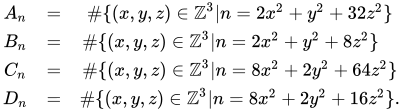
Tunnell proved unconditionally that if $n$ is an odd congruent number, then $2A_n = B_n$ and if $n$ is an even congruent number, then $2C_n = D_n$. The converse is true assuming the Birch Swinnerton-Dyer conjecture.
More precisely, if we denote by $L (s)= L(E_n,s)$ the L-function for $E_n$ over $\mathbb Q$ at $s=1$, recall that the Birch-Swinnerton Dyer conjecture states that the order of vanishing of $L(s)$ at $s = 1$ is the rank of $E_n(\mathbb Q)$.
Therefore, $n$ is a congruent number if and only if $L(E_n,s) = 0$. What Tunnel showed was that:
$L(E_n) = \begin{cases}\gamma(2A_n-B_n) & n \text{is odd}\\\gamma(2C_n-D_n) & n \text{ is even}\end{cases}$
where $\gamma$ is a non-zero constant. Note that $E_n$ always has complex multiplication over $\mathbb Q$ since $(x,y,z) \to (-x,iy,z)$ is an automorphism of order $4$.
The unconditional direction of Tunnel's criterion follows from the following theorem of Coates-Wiles in 1976:
Theorem[Coates-Wiles(1976)] If an Elliptic Curve over $\mathbb Q$ has complex multiplication by a ring of integers with class number 1 and has positive rank over $\mathbb Q$, then the corresponding L-function vanishes at $s=1$.